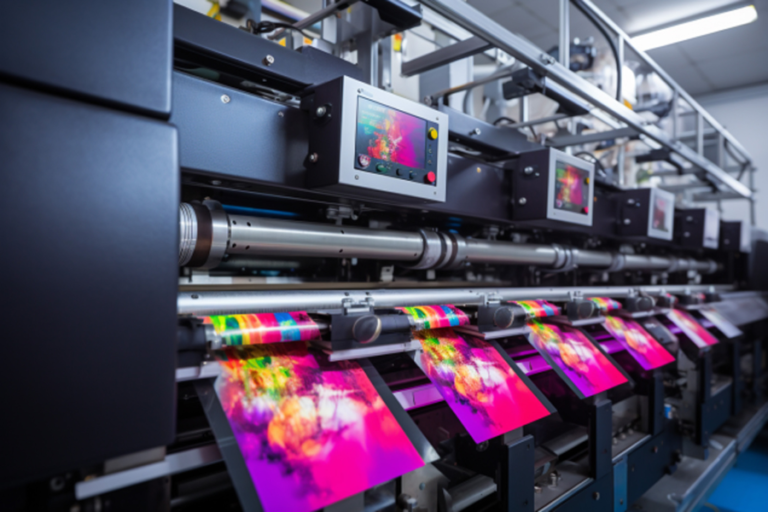
Digital printing is a method of reproducing digital images and text directly onto a physical surface — paper, cardstock, vinyl, fabric, or even rigid boards — without the need for printing plates or complex setup processes. The file goes from your computer straight to the printer, much like printing a document at home, but at a far higher quality and scale.
Modern digital printers use either inkjet technology or laser technology. Inkjet machines spray microscopic droplets of ink onto the surface, while laser printers use toner powder fused by heat. High-end commercial digital presses produce results that are indistinguishable from traditional printing to the average eye, and in some cases, even sharper for certain types of imagery.
Custom digital printing services have grown significantly over the last decade because the technology has become faster, more accurate, and far more cost-effective — especially for short runs. If you need 25 flyers today, digital printing makes that practical. Offset could not.
Offset printing (also called lithographic printing) is one of the oldest and most widely used commercial printing methods. In this process, your artwork is transferred onto metal printing plates — one for each ink color used. Those plates are mounted on cylinders, and ink is applied and then transferred from the plate to a rubber blanket, and from the rubber blanket onto the paper.
The biggest strength of offset printing is consistency. Once the press is set up and calibrated, it produces the same result on every single sheet — whether that’s the first or the fifty-thousandth. The color fidelity is exceptional, and it works with a wider range of specialty inks, including Pantone spot colors, metallics, and varnishes that digital presses cannot replicate.
However, this method requires significant upfront preparation. Creating the plates, setting up the press, and doing test runs all take time and cost money. This is why offset printing only becomes economically sensible when you’re printing thousands of copies.
The process is straightforward. You submit a print-ready file — usually a PDF or high-resolution image — and the press reads it directly. There’s no plate-making stage. The printer calibrates to your file’s color profile and begins printing almost immediately. Turnaround times are fast, often same-day or next-day for standard jobs.
This simplicity is why custom digital printing services are often the go-to for startups, small businesses, event planners, and anyone who needs quality print materials without long lead times. It also means variable data printing is easy — you can personalise each piece with a different name, address, or image.
Understanding the practical differences helps you pick the right method for the right job. Here’s how they compare across the factors that matter most:
| Factor | Digital Printing | Offset Printing |
| Setup Time | Minimal — file goes direct to press | Significant — plates must be made and press set up |
| Minimum Quantity | As low as 1 copy | Typically 500–1,000+ to be cost-effective |
| Cost (Low Volume) | Lower — no setup cost spread | Higher — setup cost dominates at low volume |
| Cost (High Volume) | Higher per unit as volume rises | Lower — cost per unit drops with volume |
| Color Accuracy | Excellent for CMYK; limited spot colors | Superior; Pantone, metallic & specialty inks available |
| Personalization | Fully supported (variable data printing) | Not practical without reprinting |
| Turnaround | Fast — often same or next day | Slower — days to weeks for setup and press time |
| Best For | Short runs, proofs, personalised print | Large-volume, brand-consistent campaigns |
Digital printing is the right choice in more situations than most people realise. The technology has improved to the point where quality is no longer a trade-off — it’s a genuine strength. Custom digital printing services work best when:
This covers a large portion of the real-world print needs of small businesses, freelancers, agencies, and event teams. If your print quantities sit below a few thousand units, digital is almost always the smarter starting point.
Offset printing still holds a strong advantage in specific situations. If your project requires absolute colour precision — for example, matching a specific Pantone shade for brand consistency across packaging and marketing materials — offset gives you control that digital cannot match yet. The same applies when you’re working with specialty finishes like metallic inks, spot UV varnishes, or uncoated paper stocks.
Volume is the other major factor. Once you cross into the tens of thousands of units — think catalogues, magazines, packaging, or mass-mailing campaigns — offset printing brings the cost per unit down substantially. At that scale, the upfront plate cost becomes negligible, and the press speed means your job gets done efficiently.
Ten years ago, it was easy to tell a digitally printed piece from an offset one. Today, for the vast majority of applications, that distinction has almost disappeared. Modern commercial digital presses operate at resolutions of 1200 dpi or higher, with colour management systems that produce consistent, accurate output across a print run.
The areas where offset still pulls ahead are very specific: ultra-fine halftone screens, exact Pantone matching, extremely large solid areas of colour on uncoated paper, and applications that require specialty inks. For standard business materials — cards, flyers, brochures, posters, stationery — custom digital printing services produce results that clients and customers will not be able to distinguish from offset output.
Both methods work across a wide range of papers and materials, but digital printing has expanded into substrates that offset cannot easily handle — including vinyl, canvas, synthetic papers, and rigid boards. This makes digital printing far more flexible for signage, display materials, and specialty applications beyond standard paper-based print.
The range of products that work well with custom digital printing services is broad. Business cards, letterheads, envelopes, brochures, flyers, posters, banners, roll-up stands, stickers, labels, packaging prototypes, photo prints, direct mail pieces, and promotional materials all fall comfortably within digital printing’s strengths. It’s also widely used for short-run book printing, custom merchandise, and branded event materials.
For businesses that update their materials regularly — seasonal promotions, new product lines, updated contact details — digital printing removes the problem of having thousands of outdated brochures sitting in a storeroom. You print what you need, when you need it, and keep everything current without waste.
Digital printing generally has a smaller environmental footprint for short runs. There’s no chemical plate-making process, less ink waste, and no need to run off hundreds of waste sheets during press setup and calibration. On-demand printing also means less overproduction — you’re not printing 5,000 copies of something just to get the per-unit cost down and then discarding the unused stock.
Offset printing, at high volume, can be run on highly efficient presses with vegetable-based inks and recycled paper, which narrows the gap. But for most small-to-medium print jobs, digital is the more responsible choice environmentally.
Ready to Start Your Print Project?
From 50 business cards to 500 brochures, we deliver high-quality printing with fast turnaround and no unnecessary minimums. We help with file setup, design support, and final delivery — making the process simple, reliable, and stress-free. Contact MYA Graphic today for a quick quote.
Q: Is digital printing suitable for professional business materials?
A: Absolutely. Modern commercial digital presses produce sharp, vibrant, high-resolution output that is fully professional. Business cards, brochures, letterheads, and marketing materials printed digitally are used by companies of all sizes. The quality difference between digital and offset has narrowed to the point where most end-users cannot tell them apart.
Q: What is the minimum quantity I can order for digital printing?
A: One of digital printing’s biggest advantages is that there is effectively no minimum. You can print a single copy if needed. This makes it ideal for testing designs, producing samples, or fulfilling small on-demand orders. Unlike offset printing, where setup costs require high minimum quantities, digital printing scales all the way down without any significant cost penalty.
Q: Can digital printing match Pantone or brand-specific colours exactly?
A: Digital presses work within a CMYK colour space, which means they produce Pantone-approximate results rather than exact spot colour matches. For most business materials this is perfectly adequate. However, if your brand guidelines require an exact Pantone match — for instance on packaging — offset printing with dedicated spot colour inks would be the more appropriate choice.
Q: How quickly can I receive digitally printed materials?
A: Turnaround times for digital printing are significantly faster than offset. Standard jobs are often ready within 24 to 48 hours after file approval. Many print providers offer same-day production for straightforward jobs submitted early in the day. This makes digital printing a practical option for last-minute events, urgent business needs, or projects where design changes come in close to the deadline.
Q: What file format should I use when submitting artwork for digital printing?
A: The preferred format for professional digital printing is a print-ready PDF with all fonts embedded, images at a minimum of 300 dpi, and 3mm bleed on all sides. Colour mode should be set to CMYK rather than RGB to ensure accurate colour reproduction. Some printers also accept high-resolution TIFF or AI files. When in doubt, ask your print provider for a spec sheet before preparing your artwork.
