If you run a business, manage a sports team, or sell custom merchandise, you have probably faced this question at some point — screen printing or digital printing? Both methods produce great results, but they are not the same. And when it comes to how long your t-shirt print actually holds up after washing, wearing, and daily use, the difference matters more than most people think.
This guide breaks down everything you need to know about durability, cost, quality, and when to use each method — so you can make the right call for your next order.
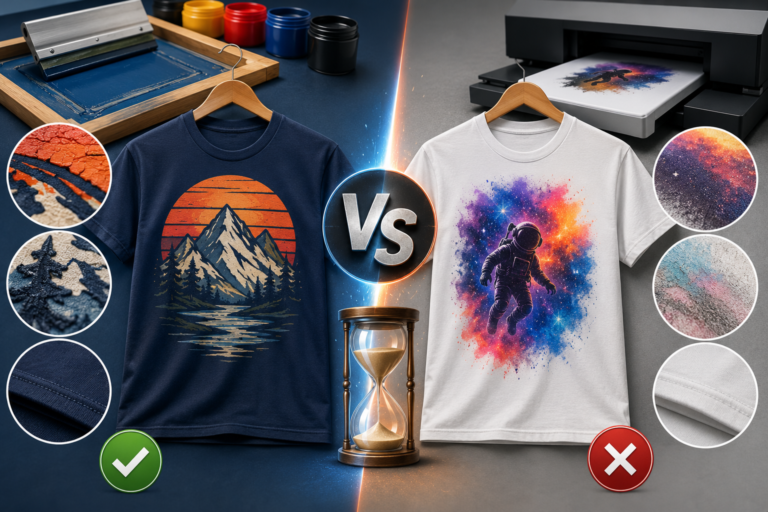
Screen printing is one of the oldest and most trusted methods in the garment industry. A mesh screen is used to push ink directly onto the fabric, one color at a time. Each color in the design gets its own screen, and the ink sits on top of the fabric rather than soaking into it.
The result is a thick, bold print with rich, vibrant colors. Screen printing has been the go-to method for bulk t-shirt orders for decades, and for good reason — the prints are tough.
Screen printing is widely considered the most durable printing method available for t-shirts. The plastisol ink used in most screen printing bonds tightly to the fabric through a heat curing process. When done correctly, a screen printed design can last for 50 or more washes without major fading, cracking, or peeling.
That durability comes from the ink thickness. Screen printed designs feel slightly raised on the fabric, and that layer of ink is what gives it staying power over time. As long as the shirt is washed inside out in cold water, the print holds up incredibly well.
The one weakness of screen printing is fine detail. Because each color needs a separate screen, highly detailed artwork with gradients or photographic elements can be difficult and expensive to reproduce.
Digital printing — often called DTG (Direct-to-Garment) printing — works more like a regular inkjet printer. A machine sprays water-based ink directly onto the fabric, and the ink absorbs into the fibers rather than sitting on top.
This method is perfect for complex, multi-color designs. You can print a full-color photograph on a t-shirt with no setup fee, no minimum order requirement, and a quick turnaround. For businesses in digital print and advertising, this is often the preferred choice for short runs, samples, or custom one-off pieces.
Digital printing durability has improved significantly in recent years, but it still falls slightly behind screen printing in terms of raw longevity. A well-maintained DTG print typically lasts between 30 to 50 washes before showing signs of fading, depending on the fabric, the ink brand, and how the garment is cared for.
The key factor is fabric type. Digital printing works best on 100% cotton because the ink bonds directly with the natural fibers. On polyester or blended fabrics, the ink does not absorb as well, which can lead to faster fading and a softer, less vibrant finish over time.
One important thing to know: DTG prints require a pre-treatment process on dark fabrics to ensure the ink shows up properly. If this step is skipped or done poorly, the print will fade much faster than expected.
Here is a straightforward look at how both methods compare across the factors that affect long-term print quality:
Read More:- Looking for Printing Near Palatine, IL? Here’s Everything You Need
The honest answer is: it depends on what you need. Neither method is universally better. The right choice comes down to your order size, design complexity, budget, and how the shirts will be used.
Screen printing makes the most sense for bulk orders, promotional merchandise, and designs that need to survive heavy, repeated use. If you are printing uniforms for a construction company, jerseys for a sports team, or event t-shirts that need to last for years, screen printing is the better investment.
It is also the more cost-effective option for large quantities. Once the screens are set up, the cost per unit drops significantly as your order size increases. For orders above 24 pieces with a simple design, screen printing almost always wins on price.
Digital printing is the right fit when you need flexibility. If you are running a small business in digital print and advertising and need to test a design before committing to a large run, DTG lets you order one or two pieces with no setup cost. It is also the only practical option for photographic prints or artwork with dozens of colors.
E-commerce sellers and print-on-demand businesses rely heavily on digital printing because it allows them to offer a wide range of designs without holding inventory. For that use case, DTG is the clear winner.
No matter which printing method you choose, the fabric itself plays a major role in how long the print lasts. This is something many businesses overlook when placing orders.
For screen printing, the weight and weave of the fabric matter. A heavier cotton t-shirt (180–200 GSM) provides a better surface for the ink to cure onto. Thin, cheap blanks tend to shrink and stretch more, which stresses the ink layer and leads to earlier cracking.
For digital printing, 100% combed ring-spun cotton is the gold standard. The smoother the fiber, the better the ink absorbs. Tri-blends and polyester-heavy fabrics reduce the quality and durability of DTG prints significantly.
At MYA Graphics, we help clients choose the right combination of fabric and printing method before the order goes into production. Getting this right upfront saves money and avoids disappointment.
Even the most durable print will not last if the shirt is washed incorrectly. Here are the care practices that make the biggest difference in extending print life:
Following these steps consistently can add years to the life of a printed garment, regardless of the method used.
Cost is often the deciding factor for businesses, so here is a realistic breakdown.
Screen printing involves setup costs for each color in the design. These setup fees (sometimes called screen charges) typically range from 15 to 30 USD per color. Once those are paid, the per-unit cost is low — often between 3 and 8 USD per shirt for bulk orders. This means screen printing gets cheaper the more you order.
Digital printing has no setup fees, which makes small orders much more affordable. However, the per-unit cost stays relatively flat regardless of quantity. A single DTG print might cost 8 to 20 USD per shirt depending on print size and complexity. For businesses in digital print and advertising that need quick samples or custom individual pieces, this is a fair trade-off.
The crossover point — where screen printing becomes cheaper per unit — is usually around 12 to 24 pieces, depending on your design complexity.
The printing industry has moved fast over the last few years. DTF (Direct-to-Film) printing has emerged as a serious competitor to both screen printing and DTG. DTF involves printing a design onto a special film, then heat-pressing it onto the garment. The result is a highly durable print that works on almost any fabric type — including polyester and nylon, which DTG struggles with.
DTF prints are proving to be more durable than standard DTG and competitive with screen printing in terms of wash resistance. For businesses that need short runs with high durability across multiple fabric types, DTF is worth serious consideration.
Hybrid printing setups — which combine screen printing for base layers with digital printing for detailed elements — are also becoming more accessible. This approach gets the best of both methods and is growing in popularity among custom merchandise brands.
Screen printing still holds the durability crown for most practical applications. If longevity is your primary concern and you are ordering in bulk, screen printing gives you the most reliable, long-lasting result per dollar spent.
Digital printing closes the gap significantly when used on the right fabric with proper care. For businesses that prioritize flexibility, short runs, or complex full-color artwork, digital print and advertising methods like DTG or DTF are the smarter operational choice — even if the print requires slightly more careful maintenance.
The best businesses do not pick one method and stick to it blindly. They match the method to the job. That is the approach MYA Graphics takes with every client order.
Whether you need bulk screen printed uniforms, short-run custom merchandise, or full-color digital prints for a campaign, MYA Graphics handles it all. We guide you through fabric selection, printing method, and design preparation — so your finished product looks sharp and lasts.
At MYA Graphics, we make the process simple from start to finish. Whether you need 10 shirts or 10,000, we help you pick the right printing method, the right fabric, and the right finish for your budget. Just share your idea and we handle the rest.
