If you work for yourself, your car spends more time in front of potential clients than your business card ever will. It sits in parking lots, waits at school pickup lines, and rolls past hundreds of people on the way to every meeting. Most solo professionals never think about that time as marketing time — but it is, and a wrapped vehicle is one of the few ways to use it without lifting a finger once the work is done.
MYA Graphics works with real estate agents, consultants, coaches, and independent contractors who are starting to treat their vehicle the same way they treat a website or a business card: as a piece of their brand that should actually look like it belongs to them.
A parked car in a grocery store lot gets looked at by dozens of people during a single errand. A car in daily traffic gets seen thousands of times a month. None of that requires a monthly ad spend, a scheduled post, or an algorithm deciding whether anyone sees it. It’s simply there, doing its job while you do yours.
For solo professionals, this matters more than it does for large companies with marketing departments and big budgets. A single person building a client base often relies on referrals, local visibility, and repeated exposure to the same community over months and years. A wrapped car adds a visual layer to that repetition — people start recognizing the vehicle before they recognize the name attached to it.
Personal branding on wheels isn’t about slapping a logo on a door panel and calling it done. It’s about making sure the vehicle communicates the same message as everything else you put your name on — your website, your social profiles, your email signature, even how you dress for a client meeting.
A wrap should answer three questions at a glance: who you are, what you do, and how someone can reach you. If a driver behind you can’t answer at least two of those in the three seconds they’re looking at your bumper, the wrap isn’t doing its job yet.
This is where working with an experienced studio matters. Good car wrapping services aren’t just about applying vinyl — they’re about figuring out what information actually belongs on a moving surface and what should stay off it.
Not every profession needs a wrapped vehicle, but a surprising number do better with one than they’d expect. Solo professionals who tend to see the strongest return include:
If your work depends on being remembered by people who saw you once and might need you later, a wrap keeps working on your behalf long after that first impression fades.
The process usually starts with a conversation about what the vehicle needs to do. Some professionals want a subtle wrap that looks closer to a color change than an advertisement. Others want something bold enough to be spotted from across a parking lot. Both are valid depending on the industry and the personality behind the brand.
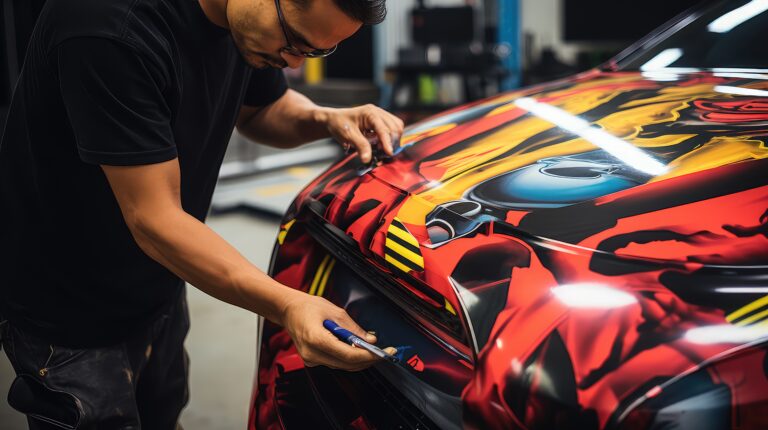
From there, a studio typically handles design, printing, and installation as one connected process. This matters because a wrap that looks great as a digital mockup can look completely different once it’s stretched across curves, mirrors, and door handles. Car wrapping services that manage design and installation together tend to catch these issues before the vinyl goes on the car, not after.
For solo professionals specifically, timing is often the bigger concern than design. Most people running their own business can’t afford to have their only vehicle out of commission for a week. Studios that offer realistic turnaround windows — and are upfront about them — make it easier to plan the wrap around a slower stretch of the schedule rather than losing income while the car sits in a shop.
This is usually the first real decision a solo professional has to make, and it comes down to budget, visibility goals, and how the car is used outside of work.
A full wrap covers the entire vehicle and gives the strongest, most consistent look. It’s the closest thing to a rolling billboard and works well for anyone who wants the car itself to be instantly identifiable, even from a distance. The tradeoff is cost — a full wrap is a bigger investment upfront, though it also offers the most paint protection underneath.
A partial wrap covers specific sections — the hood, doors, tailgate, or rear window — and costs less while still delivering a clear visual statement. This option works well for professionals who use the same vehicle for personal errands and don’t want it to feel like a company car around town. A well-placed logo and contact information on the doors is often enough to be memorable without covering every inch of paint.
Neither option is objectively better. The right choice depends on how often the vehicle is seen in a work context versus a personal one, and how much of the car someone is comfortable turning into brand space.
The design stage is where a lot of solo professionals either get it right or waste money on something that gets ignored. A few principles hold up across almost every industry:
Keep contact information simple. A phone number and a website are usually enough — cramming in every social handle and service offered turns the wrap into something no one has time to read while driving past.
Match colors to the rest of your brand. If your business cards and website use a specific palette, the wrap should use it too. Inconsistency between a website and a vehicle makes a business feel less established, even if the work itself is solid.
Leave breathing room. A wrap covered edge-to-edge in text and graphics is harder to read at a glance than one with a clear logo, a short tagline, and space around both.
An experienced design team will usually push back on ideas that look good in theory but won’t read well on a moving vehicle — and that pushback is worth listening to.
Pricing for car wrapping services varies based on vehicle size, wrap coverage, and material quality. Partial wraps are the more budget-friendly entry point, while full wraps represent a larger investment that also includes a layer of paint protection most partial wraps don’t offer.
For a solo professional weighing the cost, it helps to think in terms of cost-per-impression rather than a single upfront number. A wrap installed once can last several years, during which the vehicle is seen by thousands of people without any recurring ad spend. Compared to paid digital ads or print marketing that need to be renewed monthly, a wrap tends to work out to a lower cost over time — as long as the design actually earns attention in the first place.
A wrap is only as good as the care it gets after installation. Regular hand washing, avoiding automatic car washes with harsh brushes, and parking in shade when possible all extend the life of the vinyl. Most professionally installed wraps hold up well for several years under normal driving conditions, but neglect — especially exposure to harsh chemicals or long-term sun without any shade — will shorten that lifespan.
For solo professionals whose vehicle doubles as their main mode of transportation, this maintenance is usually no different from normal car care, just with slightly more attention paid to what products touch the surface.
Will a wrap damage my paint?
A properly installed wrap actually protects the paint underneath from sun exposure and minor scratches. When removed correctly by a professional, the paint underneath is typically in the same condition it was before the wrap went on.
Can I still sell or trade in a wrapped vehicle?
Yes. Wraps are removable, and most solo professionals have theirs taken off before selling or trading in a vehicle, revealing the original paint underneath.
How long does installation take?
This depends on coverage. A full wrap generally takes a few business days, while partial wraps and smaller decal work can often be completed in a single day.
Is a wrap worth it if I only drive locally?
Local, repeated visibility is actually where wraps perform best. Professionals who drive the same routes and neighborhoods regularly tend to see stronger recognition than those who drive long distances less frequently.
Solo professionals don’t usually have the time to manage a design team, a print vendor, and an installer separately. MYA Graphics handles the entire process under one roof — design, printing, and installation — so a single vehicle wrap doesn’t turn into three separate appointments and three separate invoices.
For anyone building a personal brand that needs to show up consistently across a website, business cards, and now a vehicle, working with one studio that understands both the design side and the technical side of vinyl application tends to produce a cleaner result. That consistency is often what separates a wrap that gets noticed from one that just blends into traffic.
If your work depends on being remembered — by a neighbor, a past client, or someone who simply saw your car parked outside a coffee shop — a well-designed wrap keeps doing that work quietly, every day, without asking for anything in return. Solo professionals who’ve made the switch usually describe the same thing: fewer cold introductions, more people who already feel like they know the name on the door before the first conversation even starts.
A short conversation with MYA Graphics about your vehicle, your industry, and how you actually use your car day to day is usually enough to figure out whether a full wrap, a partial wrap, or a smaller decal setup makes the most sense for where your business is right now.
