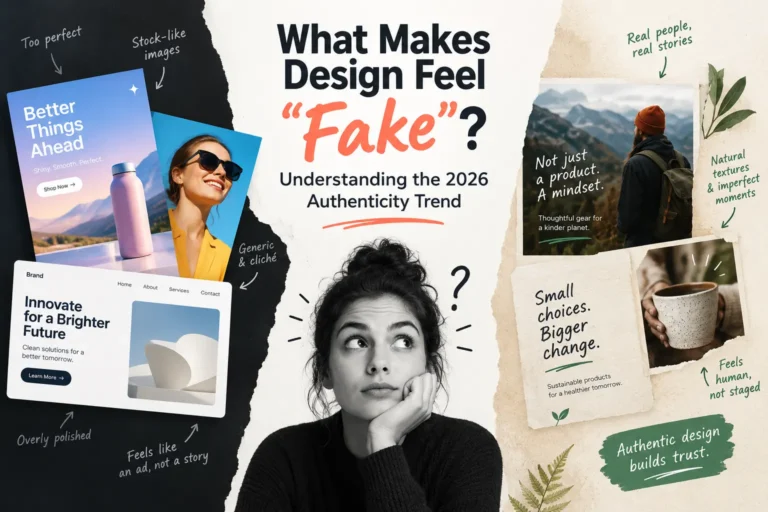
There’s a strange thing happening in the design world right now. The more polished a logo, website, or ad looks, the less people seem to trust it. A flyer with a slightly uneven texture feels more honest than a flawless, machine-generated graphic. A hand-lettered sign gets more attention than a perfectly symmetrical banner. This shift is not a passing mood. It’s a real, measurable change in how audiences respond to visuals, and it’s reshaping how businesses approach Graphic Design Elgin IL companies rely on to stand out.
If you’ve noticed your marketing materials getting less engagement even though they look “clean” and “professional,” this trend might explain why. Let’s break down what’s actually happening, why it matters, and what you can do about it.
For years, brands chased flawlessness. Smooth gradients, symmetrical layouts, and stock photography with impossibly perfect lighting were the standard. Then generative AI tools flooded the market, and suddenly everyone had access to that same polished look. Logos, banners, and social posts started looking interchangeable. Viewers began noticing a pattern: content that looked too smooth, too symmetrical, or too “on-brand” in a generic way was often AI-generated or templated.
That recognition changed behavior. People started associating over-polished visuals with mass production rather than genuine craftsmanship. A business that used to signal quality through clean design now risks signaling the opposite: that nobody actually made this, a machine did.
This doesn’t mean quality no longer matters. It means the definition of quality has shifted from “flawless” to “believable.”
Humans are wired to notice patterns, and repetition breeds suspicion. When someone scrolls past dozens of nearly identical, hyper-smooth graphics in a day, their brain starts filtering them out as noise. Visual fatigue sets in. Meanwhile, a design with a slight imperfection, an intentional smudge, a hand-drawn element, an uneven edge, breaks that pattern. It reads as evidence that a real person was involved.
Trust researchers have long pointed out that authenticity signals are processed differently than polish signals. Polish tells the brain “this was made carefully.” Imperfection tells the brain “this was made by someone real.” In 2026, audiences are prioritizing the second signal, especially in industries where trust drives purchasing decisions.
Some design choices are quietly working against your brand without you realizing it. Watch for these red flags:
None of these mean your design is bad. It might just be too generic to feel trustworthy.
Authentic design doesn’t mean sloppy or unprofessional. It means intentional. Brands leading this trend are mixing craftsmanship with personality. Think textured backgrounds instead of flat gradients, custom illustrations instead of stock art, and typography that has a little character instead of the same three “safe” fonts everyone else uses.
For local businesses working with a Graphic Design Elgin IL studio, this is actually good news. Smaller, hands-on design teams are naturally better positioned to create authentic work than large automated pipelines, because every project gets individual attention rather than a template swap.
Digital screens aren’t the only place this shift is showing up. Print materials are benefiting from the authenticity trend in a big way. A business card with a unique texture, a flyer with a distinct color choice, or packaging with a handmade feel all carry more weight than something that looks like it rolled off a generic printer template.
Physical print naturally has an advantage here. It’s tactile, it’s real, and it doesn’t disappear into an endless scroll. Businesses investing in print alongside digital design are seeing that combination build more trust than digital alone.
If you want your business to benefit from this shift rather than get lost in it, a few adjustments go a long way:
These small changes don’t require a full rebrand. They require intention, and a design partner who understands the difference between “polished” and “personal.”
Large corporations are struggling to adapt to this trend because their design pipelines are built for scale and consistency, not personality. Small and mid-sized businesses, on the other hand, can move faster. A business working with a local Graphic Design Elgin IL team can request custom work, get direct feedback, and adjust designs in ways that big brands simply can’t.
This is one of the reasons authenticity-driven design is becoming a competitive edge rather than just an aesthetic preference. Businesses that lean into it now are building trust faster than competitors still relying on generic templates.
Design in 2026 isn’t about abandoning quality. It’s about redefining what quality signals to an audience that’s grown skeptical of anything that looks too perfect. Authenticity, texture, and personality are becoming the new markers of professionalism, replacing flawless symmetry and predictable templates.
Working with a team that understands Graphic Design Elgin IL businesses actually need, one that blends creative judgment with genuine craftsmanship, makes it easier to build a brand people believe in rather than one they scroll past.
MYA Graphic has spent years helping local businesses move away from generic templates and toward branding that actually reflects who they are. From custom logos to print materials that carry real texture and personality, the team focuses on design that builds trust instead of blending in. If your current branding feels a little too polished and a little too forgettable, it might be time for a conversation about what authentic design could do for your business.
1. Why does overly polished design feel less trustworthy in 2026?
Audiences have grown used to seeing hyper-smooth, AI-generated visuals everywhere, which makes flawless design feel mass-produced rather than genuine. Slight imperfections signal human involvement, which builds more trust than perfection does.
2. Does this trend mean businesses should stop caring about design quality?
No. Quality still matters, but the definition has shifted. Instead of chasing flawless symmetry, businesses are focusing on intentional, personality-driven design that feels crafted rather than templated.
3. How can a small business make its branding feel more authentic?
Simple changes help, including using real photos instead of stock images, choosing distinct typography, and adding texture or hand-crafted elements to visuals instead of over-smoothing everything.
4. Does the authenticity trend apply to print materials too?
Yes. Physical print items like business cards, flyers, and packaging benefit from this trend just as much as digital design, since tactile, distinct materials feel more genuine than generic printed templates.
5. Why should local businesses work with a local design team for this trend?
Local design teams can offer custom, hands-on work rather than templated output at scale, which naturally aligns with the authenticity and personality that 2026 audiences are responding to.
